Manufactured Home Water Damage in Pinellas Park, FL
In a manufactured home, water goes down into the floor system, where belly insulation and decking hide it. The restoration team opens what is wet, dries the framing and replaces decking in stages.
(888) 621-2041Call about Pinellas Park manufactured home damage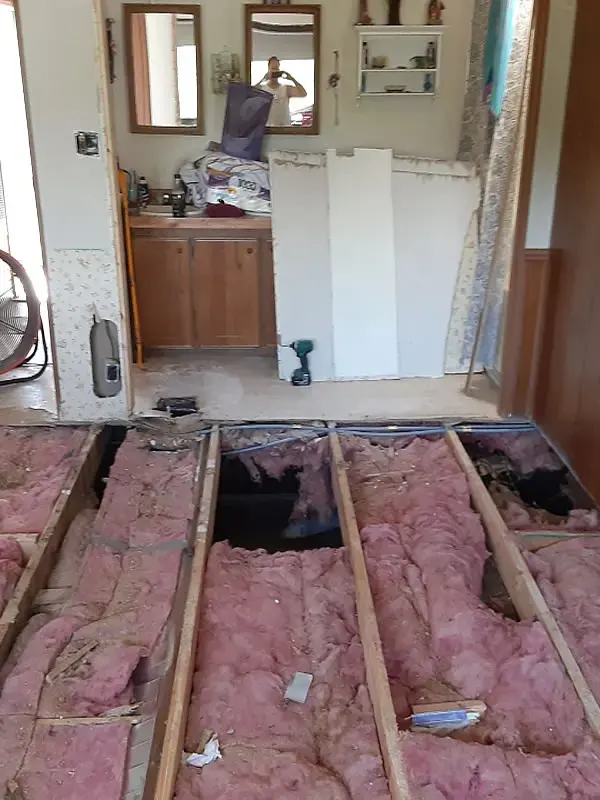
Step by step: manufactured home water damage in Pinellas Park, FL
Find the water path
A meter and thermal camera trace the water through walls and floor.
Open the floor
Flooring, wet insulation and swollen decking are cut back to sound material.
Dry the framing
Air movers and dehumidifiers dry joists and crossmembers until readings fall.
Rebuild in order
Decking, insulation and fixtures go back after the readings are logged as dry.
First moves for manufactured home water damage in Pinellas Park
- Stop the leak
Shut the fixture valve or the main, and switch off power to wet outlets.
- Check the floor
Press near the leak; a soft or bouncy spot means the decking is wet.
- Stay off weak spots
Keep people and heavy items off soft areas until the floor is checked.
- Photograph the damage
Capture stains, soft spots and any skirting damage before cleanup starts.
- Call for floor drying
Describe the source and soft rooms so underfloor checks can be planned.
What does manufactured home water damage cost in Pinellas Park, FL?
Manufactured home water damage in Pinellas Park runs from $2,000 for one room's insulation and subfloor to $18,000 or more across the whole floor. The cost calculator narrows it.
One room, insulation and subfloor
- Belly insulation pulled
- Joists and decking dried
- Readings every visit
Bath or kitchen floor replaced
- Soft decking swapped out
- Toilet or tub reset
- Moisture mapped
Belly and floor across the home
- Insulation removed widely
- Decking replaced in stages
- Complete claim file
Each figure is a typical range, not a quote. Water category, wet square footage, material class and how soon drying began move the final number. The water damage cost calculator narrows it for your own loss.
In a manufactured home the floor is a sandwich: finish flooring, decking, joists and belly insulation, with little room to see between the layers. A leak at a tub, a washer or a roof seam soaks that sandwich from the top down, and the damage is rarely visible until the floor goes soft.
Manufactured home communities in Pinellas Park
Pinellas County's October 2007 table listed at least 25 mobile home and resident-owned communities under Pinellas Park jurisdiction, with at least 3,431 spaces in total. Sunset Palms describes itself as a resident-owned community of over 500 home sites, and Park Royale is a 55+ manufactured home community.
Whether a home sits in one of those communities or on its own lot, the floor system is built the same way.
- Insulation in the belly under the floor
- Decking and particleboard subfloor
- Joists and crossmembers
- Walls, cabinets and fixtures resting on the floor
Each layer is checked, because decking that looks fine on top can be soft underneath.
How water gets under the floor
Plumbing in a manufactured home frequently runs through the floor, so a failed supply hose, a tub drain or a water heater leak can soak the belly directly. Roof and window leaks send water down the walls to the same place.
Skirting and the belly wrap can trap water, so the tech who does the walkthrough checks underneath as well as inside, using a moisture meter and a thermal camera.
Trade fact: wet belly insulation sags and holds water against the underside of the floor, so it is removed rather than dried in place, and the floor above is metered before anything is covered.
Replacing decking in stages
Swollen or soft decking is cut out in sections and replaced after the joists read dry. Fixtures such as toilets and tubs are pulled and reset, flooring is lifted where wet and drying continues underneath until the structure reaches its goal. Doing it in stages keeps the home usable where possible.
Insulation goes back after the floor is dry and the underside is closed, so the belly wrap and skirting are repaired in the right order. For a roof source, see roof leak water damage; for a supply hose or washer, see appliance and supply hose leaks.
Manufactured Home Water Damage questions in Pinellas Park, FL
Why is belly insulation removed instead of dried?
Wet fiberglass sags, holds water against the floor and dries very slowly. Removing it lets the underside of the floor dry, and new insulation goes back once readings are good.
How can I tell the subfloor is wet?
A soft, bouncy or sagging spot, a musty smell near the leak or swollen trim usually means decking is wet. A moisture meter confirms it from above and below.
Can the floor be repaired without replacing it all?
Often yes. Decking is cut out in sections and replaced only where it is soft or swollen, after the joists dry.
Does insurance cover manufactured home leaks?
Sudden leaks are often handled like those in any home, but policies differ on older seepage. Dated photos of the floor and underside help your adjuster.
Do Sunset Palms and Park Royale homes get the same service?
Crews cover manufactured home communities across ZIP 33781 and 33782, including Sunset Palms and Park Royale; the service area lists nearby cities. Equipment is chosen to fit narrow halls and small rooms.
Can drying start before the floor is repaired?
Yes. Drying starts as soon as water is extracted, and repairs follow once the joists and decking read dry. Rebuilding on damp wood causes problems later.
Manufactured home water damage across Pinellas Park, FL
Manufactured home work reaches ZIP 33781 and 33782, including Sunset Palms, Park Royale and the other manufactured home communities in Pinellas Park, where floor and belly insulation drying is done home by home.
The same service nearby: manufactured home water damage in Seminole, Kenneth City, Largo.
Wet floor in a Pinellas Park manufactured home?
The restoration team works 24/7 on manufactured home leaks, drying the floor system and rebuilding in stages with logs for the claim.